
Why Block Paving Sinks or Moves: Repair, Re-lay or Refurbish?
Uneven block paving is often treated as a surface problem, but the visible blocks are only the top part of the system. Movement can be influenced by the bedding layer, supporting base, edges, drainage, vehicle loading and previous repairs.
The right solution therefore depends on why the paving has moved, not simply how uneven it looks. For Stamp Stone’s commercial service, see block paving and CrystalSeal refurbishment.
Common Signs That Block Paving Needs Attention
- Individual blocks sitting lower or higher than the surrounding paving.
- Wheel tracks or depressions developing where vehicles repeatedly travel.
- Loose or spreading blocks near an edge.
- Open joints, loss of jointing material or local weed growth.
- Standing water appearing where the paving used to drain correctly.
- Previous patch repairs moving again.
None of those signs automatically tells you the correct repair. The surrounding area and what is happening underneath need to be checked first.
Why Can Block Paving Sink?
Settlement can occur when the support beneath the blocks changes or was not suitable for the loads being placed on it. Water can also contribute where drainage problems allow repeated saturation or material movement. In other cases, a small local disturbance may be enough to affect only a limited section.
This is why simply adding sand beneath a sunken block without understanding the cause may not provide a lasting answer. Levels, support and drainage should be considered together.
When Can Local Re-laying Make Sense?
If the problem is genuinely local and the surrounding driveway remains stable, lifting and re-laying a limited area may be worth considering. The affected section can then be assessed, levels corrected and the paving reinstated.
Local work becomes less attractive when settlement is widespread, the edges have failed, the driveway has multiple low spots or repeated movement suggests a broader base problem.
When Is Wider Refurbishment Worth Exploring?
A driveway can sometimes benefit from a wider refurbishment where the paving itself remains serviceable but cleaning, joint condition, isolated repairs or the overall finish need attention. The existing surface should still be assessed before any treatment is recommended.
Our driveway cleaning and maintenance guide explains the difference between routine care and problems that need repair first.
When Might Replacement Be the Better Route?
Where movement is extensive, drainage needs redesigning, levels need major correction or the supporting construction is no longer suitable, rebuilding more of the driveway may be more sensible than repeatedly patching the surface.
Use our replace or resurface a driveway guide and driveway sub-base and ground preparation guide to understand the wider decision.
Edges Matter More Than They Look
Block paving relies on a controlled layout and suitable restraint. Movement at boundaries can allow nearby blocks to spread or loosen, so walls, kerbs, edging and transitions to other surfaces should be checked as part of the repair.
Where the frontage also includes landscaping or boundary changes, see our fences, walls and gates beside a driveway guide.
Compare Block Paving with Tarmac Before a Major Rebuild
If a substantial rebuild is already being considered, compare the practical differences between surfaces rather than assuming the original material must be repeated. Our block paving vs tarmac homeowner guide covers appearance, maintenance and planning considerations.
See a Genuine Stamp Stone Block-Paving Example
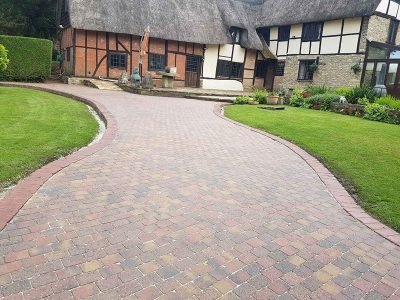
Our curved block-paving driveway and landscaping project is a genuine Stamp Stone project example. It is included as a finish and layout reference rather than as an example of a repair unless specifically stated on the project page.
Local Movement or a Wider Driveway Problem?
Look beyond the lowest block
Before deciding on a local repair, compare the affected area with the rest of the driveway. A single disturbed section near an inspection cover or edge is different from wheel tracks, several low areas or movement running across a larger section. Check whether the same problem has returned after previous repairs, whether nearby joints are opening and whether water collects in the same place. Those clues help decide whether the repair can stay local or whether more of the supporting construction needs investigation.
What to Photograph Before Asking for Advice
- Take a wide photograph of the full driveway.
- Photograph the uneven area from more than one angle.
- Show edges, walls, kerbs and adjoining surfaces.
- Include low points, drains or standing-water areas.
- Show previous patches or areas that have moved more than once.
Send the information through our Contact and Quote page if you would like Stamp Stone to assess the project.
Frequently Asked Questions
Can sunken block paving be lifted and re-laid?
Potentially, where the problem is local and the underlying support can be corrected. Wider or repeated movement may require more investigation.
Should uneven paving be sealed straight away?
Repair and stability should be considered before cosmetic or protective treatments. Sealing does not correct movement underneath the paving.
Does standing water mean the whole driveway has failed?
Not necessarily. The cause may be local or wider, but levels and drainage should be assessed before deciding on the repair method.